Ever scrolled through Facebook and wondered if a person actually wrote that post?
A recent study has revealed that over 40% of Facebook’s long-form posts are likely generated by AI, raising significant concerns about misinformation, content authenticity, and the future of social media interactions.
The AI Boom: Facebook’s Content Revolution
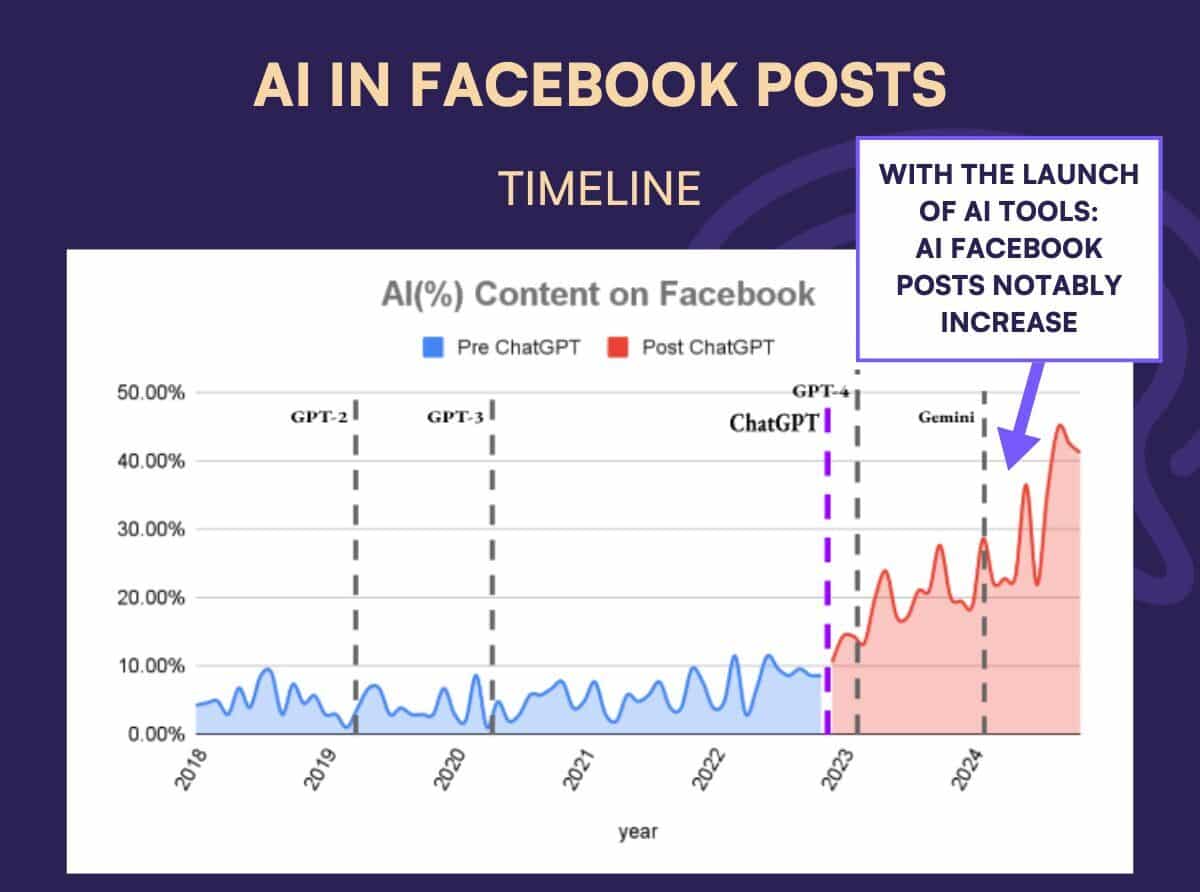
Analyzing 8,885 long-form Facebook posts from 2018 to 2024, researchers discovered a staggering shift.
Prior to 2023, AI-generated content constituted only 5.34% of posts. However, with the introduction of OpenAI’s ChatGPT in late 2022, the usage of AI surged dramatically.
By November 2024, AI-generated content reached 41.18%, representing a 4.3x increase over two years.
Before ChatGPT, AI-driven writing tools such as Jasper.ai and Copy.ai were gradually adopted. But after ChatGPT made AI text generation widely accessible, Facebook saw an explosion of AI-crafted content, with the monthly average reaching 24.05% between 2023 and late 2024.
AI’s Telltale Signs in Facebook Posts
A striking instance in the study revealed a Facebook post that included a phrase infamous for AI-generated content: “As a large language model, I don’t experience joy in the same way humans do.”
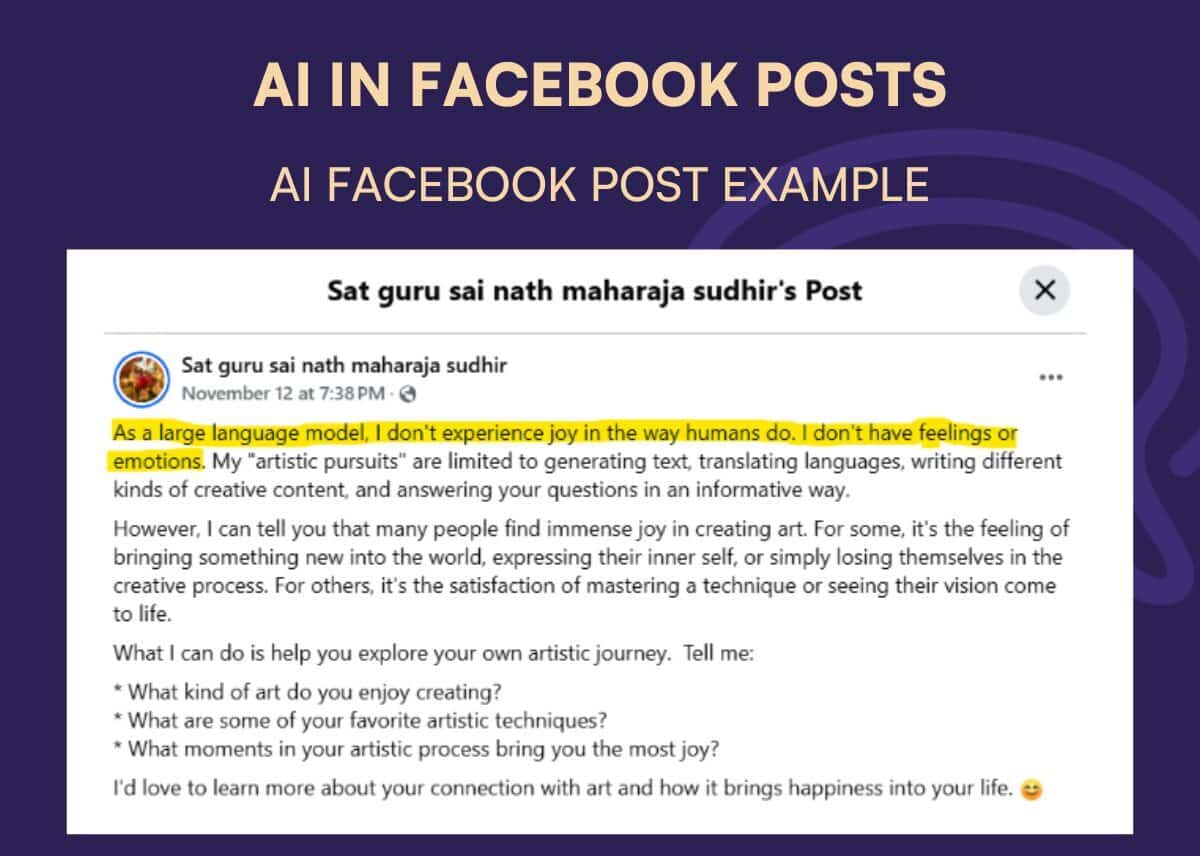
This common ChatGPT-generated response served as undeniable proof that AI-generated posts are infiltrating social media.
The study classified AI’s role in content creation into various levels—from completely AI-generated posts to human-authored content that incorporates AI assistance.
Even posts that are lightly edited with AI often triggered detection, highlighting the deep integration of AI in modern content creation.
What This Means for Facebook Users
With AI-generated content overtaking nearly half of Facebook’s long-form posts, the implications are enormous:
- Fake or Fact: Users may struggle to differentiate between human and AI-created content, leading to widespread distrust in online interactions.
- Misinformation on the Rise: AI-generated content, while often accurate, can be manipulated to spread false narratives at a massive scale.
- Shifting User Engagement: AI-generated content is optimized for virality, potentially pushing human-written posts into obscurity.
- Threat to Authenticity: Content creators, influencers, and marketers may face challenges as audiences begin questioning the originality of their work.
AI’s Social Media Takeover: Not Just a Facebook Problem
Facebook isn’t the only platform seeing an AI content surge. Similar patterns have emerged on LinkedIn, Reddit, and even Google Search.
A separate study found that more than half of long-form LinkedIn posts are likely AI-generated, while AI content spikes have been detected across multiple online platforms.
This raises an urgent question: Are we heading toward an internet where most content is AI-generated?
The Future of AI in Social Media: What’s Next?
As AI continues reshaping how content is created and ranked, businesses need to rethink how they optimize for AI-first platforms like ChatGPT and Google’s AI Overviews. AI SEO Services offered by Stan Ventures help brands stay discoverable in this new landscape.
AI-generated content is only expected to grow. Here’s what’s likely on the horizon:
Stronger AI Detection Tools: Platforms may ramp up efforts to identify and label AI-generated content.
Mandatory AI Disclosures: Social media companies could introduce transparency measures to inform users when content is AI-created.
Tighter Content Regulations: Expect stricter rules on AI-generated misinformation and automated content moderation.
AI-Powered Social Media Marketing: Businesses will increasingly leverage AI for advertising, content generation, and customer engagement.
New Ethical Challenges: The role of AI in shaping public opinion, influencing trends, and political discourse will continue to spark debate.
How to Navigate a Social Media Landscape Flooded with AI
Users must stay vigilant in this evolving digital space. Here’s what you can do:
Check the Source: Be wary of posts that lack clear authorship or reliable sources.
Spot AI Patterns: Generic, overly structured language and phrases like “As a large language model” often indicate AI involvement.
Engage with Real People: Support content creators who are transparent about their writing process.
Stay Educated: Keep up with AI developments and how they impact online interactions.
Demand Transparency: Advocate for clearer labeling and better AI content detection tools.
Key Takeaways
- Over 40% of long-form Facebook posts are likely AI-generated as of November 2024.
- AI-generated content on Facebook has surged 4.3x since ChatGPT’s launch in 2022.
- AI-generated posts are often detectable by recurring phrases and unnatural language.
- Other platforms, including LinkedIn and Reddit, are also experiencing a rise in AI-generated content.
- The future of social media will involve more AI detection, regulation, and ethical discussions.

Dileep Thekkethil
AuthorDileep Thekkethil is the Director of Marketing at Stan Ventures, where he applies over 15 years of SEO and digital marketing expertise to drive growth and authority. A former journalist with six years of experience, he combines strategic storytelling with technical know-how to help brands navigate the shift toward AI-driven search and generative engines. Dileep is a strong advocate for Google’s EEAT standards, regularly sharing real-world use cases and scenarios to demystify complex marketing trends. He is an avid gardener of tropical fruits, a motor enthusiast, and a dedicated caretaker of his pair of cockatiels.