
A new report has revealed a striking picture of how Americans are engaging with AI tools versus traditional search engines. According to data from Datos, analyzed by SparkToro, more than 20% of Americans now use AI tools 10 or more times per month, while nearly 40% use at least one AI tool once per month.
Yet, despite the surge in AI adoption, traditional search remains virtually untouched: 95% of Americans continue to use search engines monthly, with a stunning 86% classed as heavy users.
The numbers prompt an inevitable question: if AI tools are rising so fast, why hasn’t Google or Bing seen a meaningful dip? Is AI supplementing search rather than replacing it? Let’s see.
What the Data Really Shows About AI vs. Search
The analysis compared usage of major search engines (Google, Bing, Yahoo, DuckDuckGo) against leading AI platforms (ChatGPT, Claude, Copilot, Gemini, Perplexity, Deepseek). Across millions of U.S. devices, the findings confirmed what some suspected but few could quantify: search is not declining in the face of AI growth.
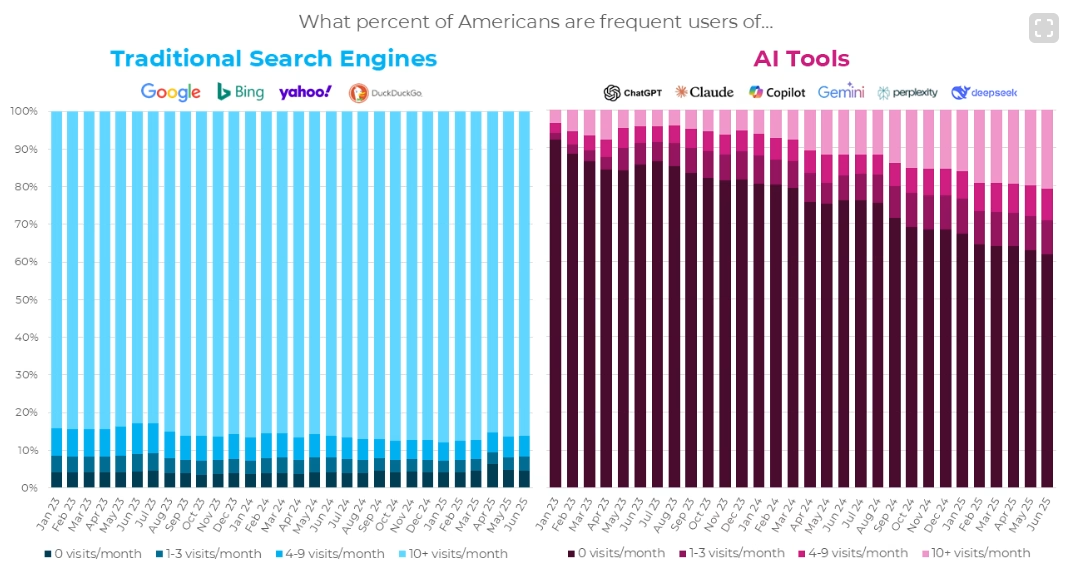
Since January 2023, AI tool adoption has grown nearly fivefold, from just 8% of Americans to 38%. Meanwhile, search usage has remained stable, dropping by less than one percentage point in two and a half years. That’s practically no change in the face of the biggest technological disruption narrative of the decade.
This puts into perspective the oft-repeated claim that “AI will kill Google.” As the report bluntly points out, that claim has been fueled more by media hype and influencer hot takes than by data.
And here’s a fascinating twist: when new users adopt ChatGPT, their Google search usage actually goes up. Data from Semrush shows that people who begin using ChatGPT search more on Google in the following months, not less. AI doesn’t cannibalize search—it expands overall digital information-seeking behavior.
Heavy Users: Who’s Really Driving Adoption?
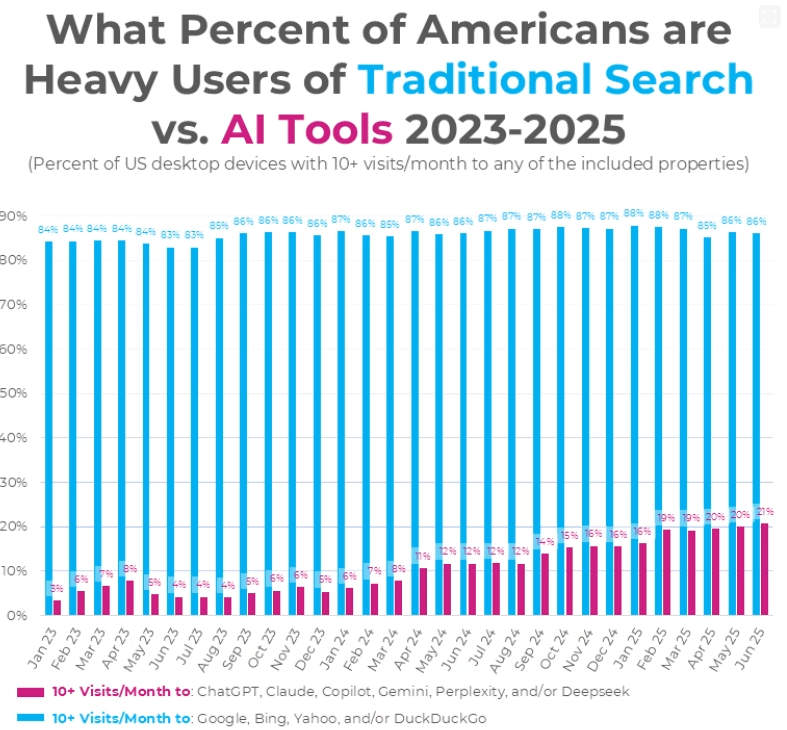
The divide becomes even clearer when we look at heavy users—those who interact with these tools 10 or more times per month.
For traditional search engines, heavy usage is the norm. In Q1 of 2023, 84% of desktop users were heavy searchers. By Q1 of 2025, that number actually climbed to 87%, a remarkable feat for a technology that has existed for nearly three decades.
AI tools, meanwhile, are catching up but from a much smaller base. Heavy AI use rose from just 3% of Americans in 2023 to 21% by mid-2025. The trajectory is impressive but growth has begun to slow. Since September 2024, AI adoption has not experienced a single month of 1.1x growth or more.
So what does this tell us? Probably that the early adopters—knowledge workers, students, and tech-savvy professionals—are already on board. For AI tools to keep expanding, they will need to convince less obvious groups like retail workers, healthcare professionals, even retirees that these tools can add value to their daily lives.
Is AI Adoption Plateauing?
The slowing growth rate is one of the most intriguing parts of this report. After meteoric adoption in 2023 and 2024, AI tools now appear to be heading toward a plateau. Unless providers like OpenAI, Anthropic or Google Gemini find new hooks, the U.S. adoption curve could stabilize in the next 12–24 months.
Think of it like social media. Platforms like Facebook and Instagram exploded to 75% U.S. adoption within a decade. AI, by comparison, is at about 38% penetration after two and a half years. That’s still huge, but the gap suggests AI may not be a universal utility in the way social platforms became.
This does not mean AI tools are not sticky. In fact, the report points out that many AI sessions are tied to education, with nearly a quarter of ChatGPT prompts linked to school projects. That seasonal pattern even shows up in usage data, where summer months bring a noticeable dip—paralleling the drop in classroom-related activity.
What About Search Volume?
If AI tools are growing but search is not declining, then how many searches are people actually making? The report shows that search volume hasn’t just remained steady—it’s actually grown slightly in most months compared to years past.
The exception? June 2025, where both AI usage and search queries dipped at the same time. Again, the likely explanation is education. When students go on summer break, both research-related Google searches and ChatGPT prompts fall.
This correlation is telling. It suggests that search and AI are serving complementary roles in information gathering, especially in academic and professional contexts.
Why Isn’t AI Replacing Search?
This is the question that every investor, tech journalist, and marketing professional keeps asking. If AI is so powerful, why has not it dethroned search?
The answer lies in the fundamental difference between the two experiences. Search engines, particularly Google, are designed to index the open web, providing a range of links and perspectives. AI tools, on the other hand, specialize in synthesizing and summarizing information into direct answers.
When you want a list of the best restaurants in your city, you go to Google. When you want a draft of an email to your boss, you go to ChatGPT. they are not competing in the same lane but they are parallel tools serving different cognitive tasks.
This might explain why, despite dire predictions, search continues to grow even among heavy AI adopters.
The Media vs. The Data
One of the more biting observations in the report is that the “AI vs. Search” narrative is largely manufactured. Influencers on LinkedIn and X thrive on bold predictions—“Google is dead!” but the data paints a very different story.
In reality, Google traffic is declining for publishers, but not because of AI tools like ChatGPT. The culprit is Google itself, with zero-click answers and AI overviews increasingly keeping users on the search page rather than pushing them to external websites.
So while AI may be grabbing headlines, the real disruption to publishers comes from changes within Google’s own ecosystem.
What Does This Mean for Marketers and Businesses?
For businesses and marketers, the lesson is straightforward: AI is not replacing search but it is expanding the digital landscape. Which means strategy needs to evolve, not pivot away from search altogether.
If you serve a professional audience, analyzing their adoption of AI tools matters more than broad national stats. Financial advisors, for example, may use AI differently than healthcare practitioners. Understanding your customer’s digital behavior—are they heavy searchers, casual AI users, or both—should drive your outreach strategy.
And here’s a self-reflection moment: how many businesses have overreacted to AI hype, slashing SEO budgets under the assumption search was dying? This report is a wake-up call that SEO remains critical arguably more than ever because search demand hasn’t shrunk.
What’s Next for AI and Search?
The report concludes with a cautious outlook: AI adoption will likely continue, but at a slower pace. Unless the next wave of tools creates broader appeal, the ceiling for AI usage may be lower than expected.
Meanwhile, traditional search isn’t going anywhere. With nearly 95% of Americans still searching monthly and 87% searching 10+ times per month, search remains one of the most entrenched behaviors on the internet.
To me, the most important takeaway is this: AI tools aren’t the end of search, they are the beginning of a new ecosystem where both coexist. Search engines remain the foundation, and AI tools are the accelerators layered on top.

Dileep Thekkethil
AuthorDileep Thekkethil is the Director of Marketing at Stan Ventures, where he applies over 15 years of SEO and digital marketing expertise to drive growth and authority. A former journalist with six years of experience, he combines strategic storytelling with technical know-how to help brands navigate the shift toward AI-driven search and generative engines. Dileep is a strong advocate for Google’s EEAT standards, regularly sharing real-world use cases and scenarios to demystify complex marketing trends. He is an avid gardener of tropical fruits, a motor enthusiast, and a dedicated caretaker of his pair of cockatiels.
